Here is an honest question worth sitting with: when did you last check if your website is actually doing its job?
Not just that it is live. Not that it looks good on your phone. But that it is bringing in real business, ranking where it should, and turning visitors into customers.
Most business owners build a website, launch it, and then move on. The site becomes a thing that exists, rather than a thing that works. The good news is that measuring how your website performs is not complicated. You just need to know what to look at and what it means when the numbers are off.
Start With One Question: What Is This Website Supposed to Do?
Before looking at any numbers, get clear on what success actually means for your specific site. A website's goal changes depending on the business.
For a service business, success might mean enquiries coming through the contact form. For an online store, it is purchases. For a restaurant, it might be table reservations or directions clicks. For a personal brand, it could be newsletter signups or portfolio views.
Define the goal first. Every metric you track should point back to it. Without this, you are just watching numbers move without knowing if they mean anything.
Traffic: How Many People Are Actually Showing Up
Traffic is the most basic measure — the number of people visiting your site in a given period. You can see this through Google Analytics (free to set up, connects directly to your site).
But raw visitor numbers only tell part of the story. The smarter questions are:
- Where is the traffic coming from? Is it Google search? Social media? Direct links? People typing your URL? Each source tells you something different about how people are finding you.
- Is it growing over time? A site that had 200 visitors last month and 400 this month is moving in the right direction. A site stuck at the same number for six months is a signal something needs attention.
- Who is the traffic? Are visitors based in your target city or country? Are they the kind of people who would actually buy from you?
Traffic without context is just a number. Traffic with context is a direction.
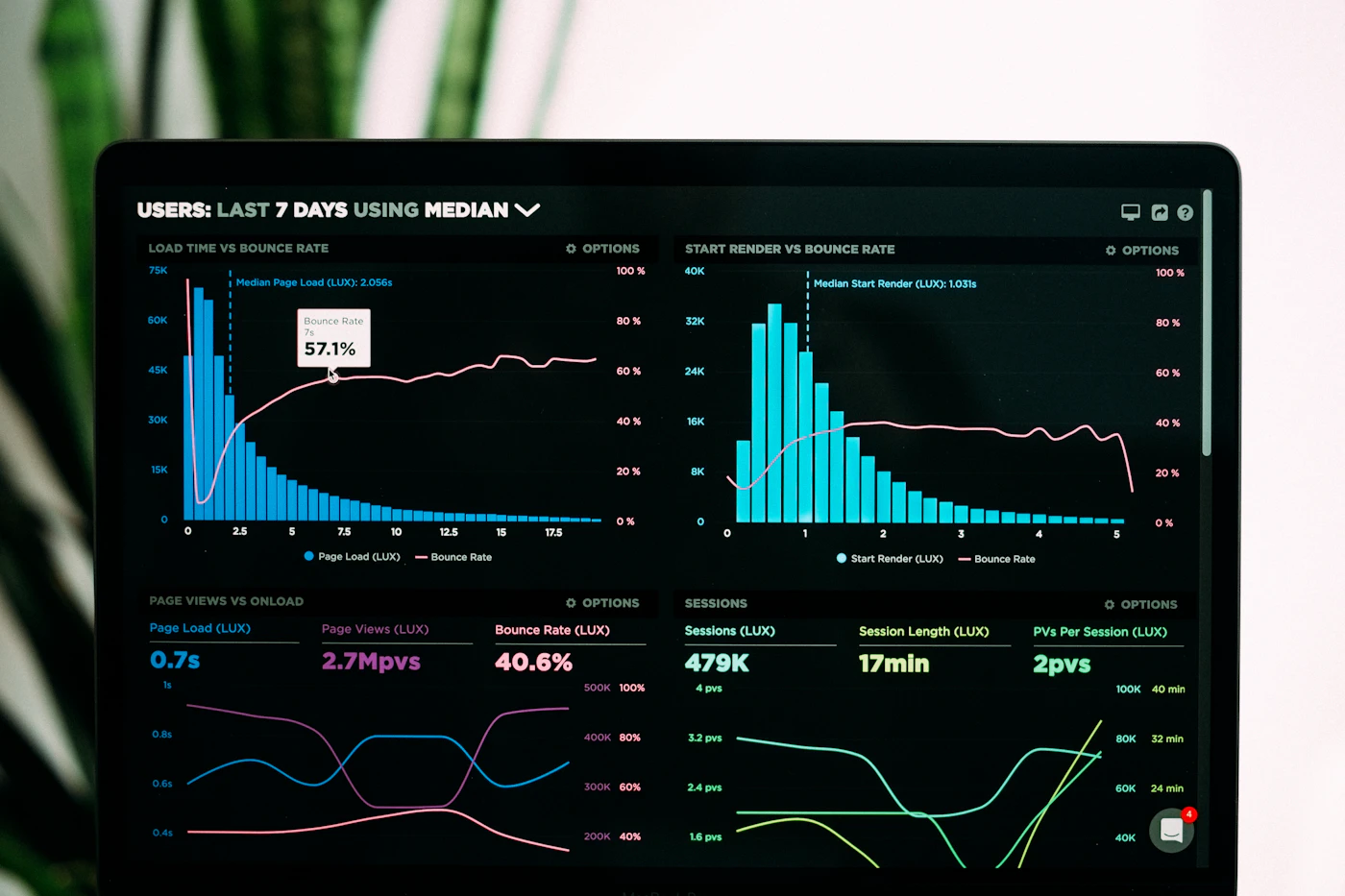
Bounce Rate: Are People Staying or Running?
Bounce rate is the percentage of people who land on a page and leave without clicking anything else. A high bounce rate is not always bad — it depends on the page. Someone who lands on your contact page, reads your number, and calls you has technically "bounced" but that is a win.
Where a high bounce rate is a problem is on pages that are supposed to pull people deeper. Your homepage. Your services page. Your pricing page. If most people are landing there and leaving immediately, the page is not doing its job.
Common reasons people bounce:
- The page loads too slowly and they get impatient
- The content does not match what they expected to find
- The page is hard to read or navigate on mobile
- Nothing on the page gives them a clear reason to stay
If you are seeing a high bounce rate on an important page, that page needs a look. Sometimes it is a speed issue. Sometimes it is a message issue. Usually it is fixable.
Conversion Rate: The Number That Matters Most
Conversion rate is the percentage of visitors who complete the action your site is designed to drive — a form submission, a purchase, a booking, a call click.
If 500 people visit your site and 10 of them fill out your contact form, your conversion rate is 2%. That is a reasonable baseline for most service businesses. E-commerce typically runs a bit lower, around 1 to 3%.
The point is not to obsess over a specific percentage. The point is to improve it over time. Small improvements in conversion rate have a significant impact on revenue without needing to increase traffic at all.
Things that tend to move conversion rate:
- A clearer, more direct call to action
- Faster page load speed (every second of delay drops conversions noticeably)
- Better social proof — reviews, results, client names where possible
- Reducing friction in the contact or checkout process
If your traffic is solid but your conversion rate is low, the problem is on the page itself, not in how many people are finding you.
Search Rankings: Can People Even Find You on Google?
This one matters especially for small businesses who rely on local customers. Google Search Console (also free) shows you exactly which search terms are bringing people to your site and what position you are showing up in.
If you run a logistics company and you are not appearing in the first page of results when someone searches for logistics companies in your city, you are invisible to a large portion of potential customers. They are finding your competitors instead.
Rankings take time to build, but they are worth tracking consistently. If you are publishing content, updating pages, and building backlinks, you should see your positions gradually improve over weeks and months. If they are not moving at all, something in your site's technical setup or content strategy needs fixing.
Page Speed: Faster Is Not Just Better, It Is Expected
Page speed is both a user experience issue and a ranking factor. Google measures it. Users feel it. A site that takes four or five seconds to load on a phone will lose a significant portion of visitors before they even see your content.
Google's free tool — PageSpeed Insights — gives your site a score out of 100 and tells you exactly what is slowing it down. A well-built site should score above 85 on mobile without much effort.
If your score is low, the culprit is usually one of a few things: uncompressed images, too many third-party scripts loading at once, or a template that generates more code than it needs to. These are fixable, but fixing them properly usually requires someone who can get into the code rather than just toggling settings.
What to Do When the Numbers Are Off
Measuring is only useful if you act on what you find. Here is a simple way to think about it:
- Low traffic usually points to an SEO problem — your site is not showing up for the searches that matter. The fix is content, backlinks, and technical SEO.
- High traffic but low conversions points to a page problem — people are arriving but not doing anything. The fix is usually clarity, speed, or trust signals.
- High bounce rate on key pages points to a mismatch between what people expected and what they found — or the page is too slow. Both are addressable.
- Low search rankings points to either a technical issue holding the site back or not enough relevant content for Google to work with.
None of these problems are permanent. They are just signals telling you where to direct attention.
You Do Not Need to Watch Everything Every Day
A weekly or bi-weekly check is enough for most small businesses. Set up a simple dashboard in Google Analytics that shows you traffic, top pages, and conversions at a glance. Check Google Search Console once a week to see if anything unusual is happening with your rankings.
The goal is not to become obsessed with metrics. It is to make sure your site is earning its place in your business rather than just sitting there.
If you already have a site and you are not sure how it is performing, we offer a free website audit that breaks down exactly what is working, what is not, and what to prioritise. And if you are ready to build something new, start your project here.


